


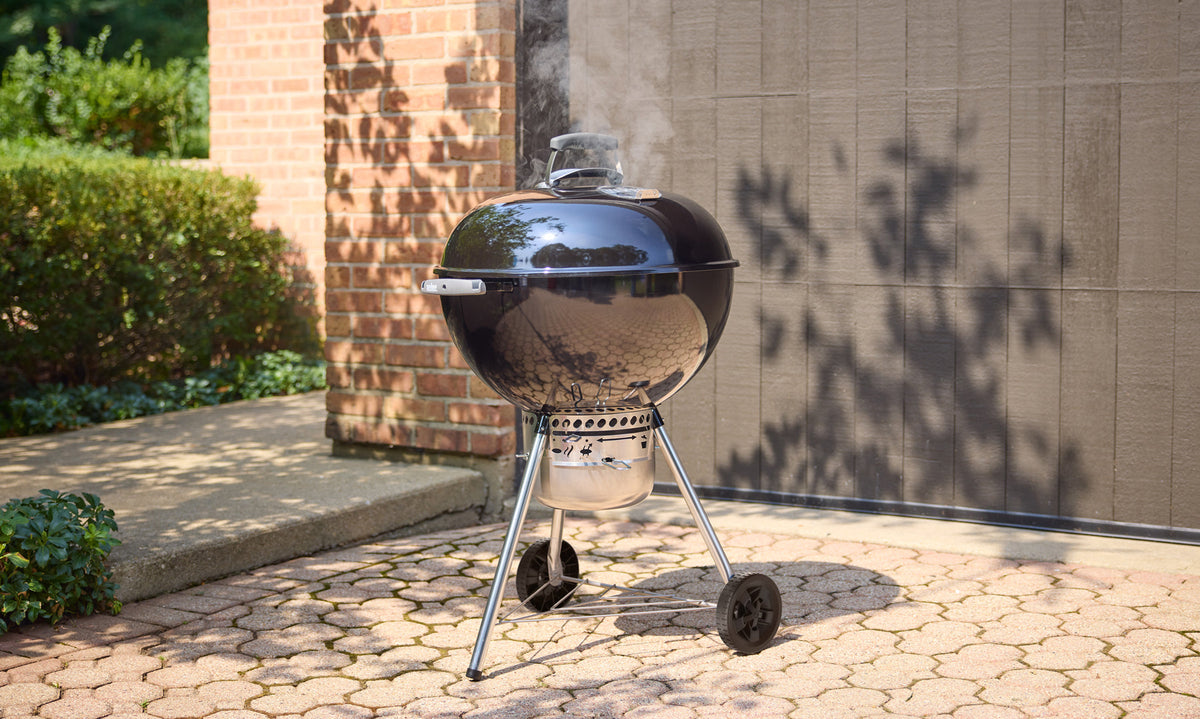
There’s a moment that happens on barbecues everywhere. The steak hits the grill, it starts to sizzle, and instinct tells you to stand there and watch it cook.
But if you’re cooking on a Weber, there’s one simple thing you can do to get more from your barbecue.
Close the lid.
Did you know that Weber barbecues have been specifically designed to cook with the lid down? It’s what helps create that unmistakable barbecue flavour, keeps your food juicy, and reduces flare-ups. And it’s been that way since the very beginning.
It all started with a lid.
Back in 1952, George Stephen loved barbecuing, but wasn’t satisfied with the flat-top brazier-style barbecues available at the time. He wanted more control over his cooking, whatever the weather. And he came up with something completely different: a barbecue with a lid.
That idea became the original Weber Kettle. George quickly realised that the lid wasn’t just there to cover the barbecue. It completely changed the way the barbecue cooked. More even heat. Fewer flare-ups. Juicier food. All with that unmistakable barbecue flavour.
More than 70 years later, cooking with the lid down is still at the heart of the Weber cooking experience (with a couple of exceptions when using Weber Slate griddles!).
How does cooking with the lid down create more flavour?
Imagine a steak sizzling on your barbecue. As the steak cooks, juices and fats drip through the cooking grill, falling onto the charcoal or Flavorizer Bars™ below. They sizzle, smoulder and create smoke.
And that smoke is flavour.
With the lid down, you’re trapping that smoky goodness inside your barbecue, circulating around your food as it cooks. Instead of escaping into the air, it becomes a part of the cooking process.

What about juicier meat?
When you cook a steak over direct heat, there are 2 different types of heat working together. Radiant heat from the fire (solid fuel or gas) sears the surface of the meat, while conductive heat (from the cooking grills) creates those distinctive grill marks. When you cook with the lid down, another type of heat enters the picture: convection heat.
Convection heat circulates around the inside of your barbecue and around your food, cooking it from all sides (like a roast), while the radiant and conductive heat continue to sear your meat. Think of it almost like grilling and roasting at the same time.
Can I really use my Weber like an oven?
Absolutely.
Once you understand how convection heat circulates inside your barbecue with the lid down, a whole new world of cooking opens up.
When you set your barbecue up for indirect cooking, you don’t cook food directly over a heat source. Hot air circulates around the food (that’s convection heat again), rather than cooking it directly from underneath.
To use your barbecue like a convection oven to roast, bake, or low and slow cook, you will need to set your barbecue up for indirect cooking (refer to your barbecue’s User and Recipe Guide for setup information).
This means your barbecue isn’t just for steak, chops, and sausages. It’s for Sunday roasts. It’s for game-day pork ribs. Bread. Desserts.
If you can cook it in an oven, there’s a good chance you can cook it on your Weber.

`
Does cooking with the lid down save gas?
Yes, and the reason is pretty simple.
When you cook with the lid down, the heat isn’t escaping out into the open air; so your grills stay hotter and the barbecue works more efficiently.
And because your food cooks quicker, your barbecue is fired up for less time, saving gas.
What about flare-ups?
If you weren’t already convinced about lid-down cooking, there’s another significant benefit. It can help reduce flare-ups.
Cooking with the lid down limits the oxygen available to feed a flare-up, meaning the chance of flare-ups is reduced. Of course, keeping your barbecue clean helps ‘tame the flame’, too.
The bottom line
At Weber, we have a saying: “If you’re looking, you ain’t cooking.”
And when you understand what’s happening underneath your lid when you barbecue, it makes perfect sense.
The lid helps circulate heat. Keeps in those smoky flavours. Cooks your food efficiently, and gives you the versatility to grill, roast, bake, or cook low and slow.
So, next time you put something on your Weber, resist the temptation to watch it cook. Close the lid. Let the Weber do the work.


