


Instructions
- Using a very sharp knife, round off the corners of the brisket. Make sure the brisket has no 90-degree angles. This helps the heat to move aerodynamically across the meat. Trim the fat on the fatty side of the brisket to about 8 mm thick, but no less.
- On the meatier side, remove the web-like membrane covering the surface so the coarsely grained meat underneath is visible.
- Remove any hard clumps of fat from either side of the brisket. Note the wedge-shaped section between the point and flat; be sure to cut away most of that fat. If you don’t, that fat will never melt (render).
- In a small bowl, stir together the pepper and salt. Season the bottom of the brisket first and the fatty side last, making sure you apply the rub evenly on all sides. Refrigerate the brisket until ready to smoke (you can do this up to 12 hours in advance).
- Prepare the charcoal barbecue for cooking using indirect very low heat (105°C-135°C) with your desired smoking wood chunks.
- View Grill Skill for setting up your 57 cm Kettle for Low and Slow Cooking
- Prepare your barbecue or smoker for cooking using indirect very low heat (105°C- 135°C). Install a Wet Smoke Kit under the cooking grills, or add a large drip pan filled with tap water onto the lower cooking grill.
- View Grill Skill for setting up your Pellet Barbecue or Smoker for Low and Slow Cooking
- Once the barbecue has preheated and smoke is visible, brush the cooking grills clean with a wire brush.
- Once your barbecue has preheated to the set temperature, brush the cooking grills clean with a wire brush.
- Place the brisket, fat side up, on the top cooking grill and close the lid. Cook over indirect very low heat, with the lid closed as much as possible.
- Cook 4 to 5 hours. Achieving surface colour indicates a good “bark” has formed, and the brisket will no longer absorb much smoke. The internal temperature in the thickest part of the brisket will be around 65° to 71°C, but colour is the primary indication of a good bar
- Place the brisket, fat side up, on the top cooking grill and close the lid. Cook over very low heat, with the lid closed as much as possible.
- Arrange two sheets of 90 cm-long pink butcher’s paper side by side, overlapping slightly. Fill a spray bottle with the vinegar and water mixture, and spray the brisket all over. Transfer the brisket, fatty side up, to the centre of the paper. Fold one long side of the paper over the brisket, bring each short side in and over, then roll it up until wrapped and sealed (like a burrito).
- Place the wrapped brisket, fat side down, on the cooking grill over indirect very low heat. Adjust the heat of the smoker or barbecue as needed to maintain a temperature between 105° and 135°C.
- Cook, with the lid closed, until the meat is so tender that when you press it with your fingers through the paper, it feels like a giant marshmallow or sponge. This will probably take 5 to 7 hours more.
- Place the wrapped brisket, fat side down, on the top cooking grill over very low heat. Adjust the heat of the smoker as needed to maintain the temperature between 130° and 140°C.
- At that point, the internal temperature should be 94° to 96°C in the flat and 98° to 99°C in the point, though tenderness is a more important indicator of doneness. The total cooking time depends on the breed of cattle and other characteristics of the meat. A common mistake is taking the brisket off too early.
- Transfer the brisket, still wrapped in the butcher's paper, to a dry, insulated cooler or turned-off oven. Close the cooler or oven and let the meat rest for 2 to 4 hours. Don’t skip this step! It helps loosen the muscles and allows moisture to reabsorb into the brisket. The ideal serving temperature of the brisket is 60° to 63°C.
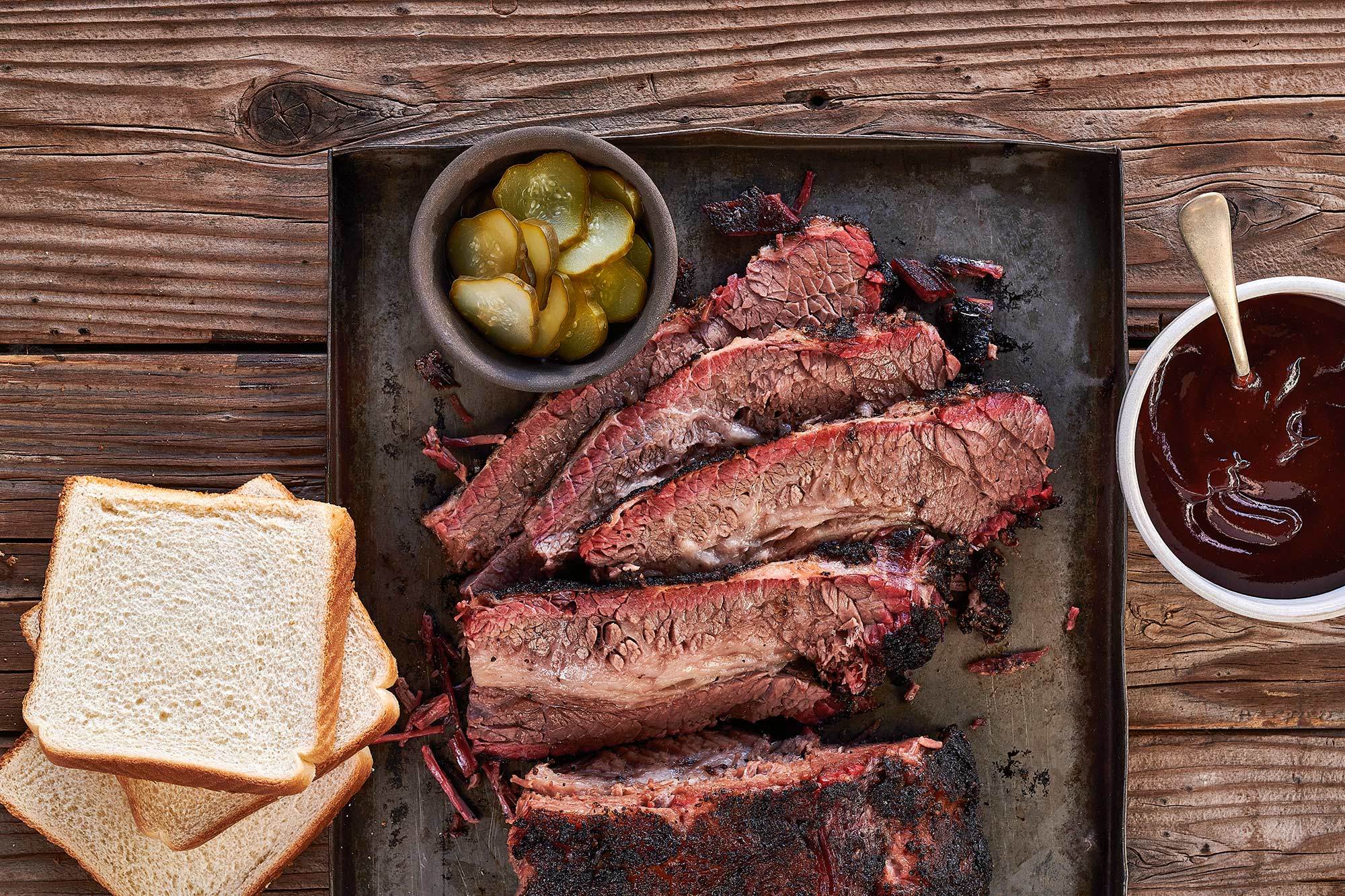
- Unwrap the brisket and set it on a cutting board, being careful to keep the precious meat juices in the butcher's paper. Starting with the flat, cut the brisket across the grain into thin slices.
- The grain runs differently in the point section, so once you get to that portion of the brisket, you’ll need to turn your knife. First, cut the point in half, then slice each portion across the grain. Serve the brisket warm on buns or bread with barbecue sauce, if using.
Brisket Perfection:
A properly cooked brisket is tender but not delicate. If a pencil thick slice falls apart as you are slicing it, that’s overcooked. If, on the other hand, that slice comes apart easily when you tug on it from opposite ends, that’s sheer brisket perfection.
Wrap it Up:
You may hear BBQ aficionados talking about wrapping their meat in butcher’s paper. No, not the white sheets used for school projects. This is a pink—or peach—coloured paper that is used to help protect the meat from drying out once it has developed its beautiful dark bark/crust.
Spray
Try Weber Connect
For Smart Barbecuing


